Workzenly makes time clock, scheduling, PTO and payroll software, and it appears in this list as one option. We researched every product on its own website on November 7, 2026. No company paid to be included. Features and prices change, so check each vendor’s site before you buy.
The best employee scheduling app for most US hourly teams is When I Work if you want auto-scheduling at a low per-user price, Homebase if you run one location and want to start free, and Deputy if you have several sites or work under a predictive scheduling law. Restaurants should look first at 7shifts, and crews in the field at Connecteam.
This list is for owners and managers of shift-based teams in restaurants, retail, healthcare, cleaning, warehouses and field services who are replacing a spreadsheet or a group text. Every app below lets you build a weekly schedule, publish it to employees’ phones and handle swaps or open shifts. The best employee scheduling app for you depends on price model (per user or per location), free plan limits, auto-scheduling, time clock and payroll. If you only need a printable grid for now, start with our free employee schedule templates.
Top picks at a glance
 When I WorkBest overall for hourly teams
 HomebaseBest free plan for one location
 DeputyBest for compliance and multiple sites
 ConnecteamBest for field and deskless crews
 7shiftsBest for restaurants
 SlingLowest per-user price
Comparison table
| Tool | Best for | Free plan or trial | Starting price | Platforms |
|---|---|---|---|---|
| When I Work | hourly teams that want auto-scheduling at a low per-user price | 14-day free trial; no free plan | $2.50 per user/month (Essentials) | Web, iOS, Android |
| Homebase | single-location businesses that want to start free | Free for 1 location, up to 10 employees | $30 per location/month (Essentials) | Web, iOS, Android |
| Deputy | multi-location teams and cities with fair workweek laws | Free trial up to 31 days; no free plan | $5 per user/month (Lite) | Web, iOS, Android, tablet kiosk |
| Connecteam | field, cleaning and construction crews | Free for up to 10 users; 14-day trial | $29/month for the first 30 users (Basic, annual) | Web, iOS, Android |
| Sling | the lowest per-user price, with a free plan up to 30 users | Free for up to 30 users; 15-day trial | $1.70 per user/month (Premium, annual) | Web, iOS, Android |
| 7shifts | restaurants that schedule against POS sales | Free plan: 1 location, up to 15 employees | $39.99 per location/month (Essentials, up to 30 employees) | Web, iOS, Android |
 Workzenly | businesses that want schedules, time and payroll in one system | Book a demo | Book a demo | Web, employee phone app, shared tablet clock |
 ZoomShift | small teams that want a free plan up to 20 users | Free for up to 20 users, 1 location; 14-day trial | $2 to $2.50 per active user/month (Starter) | Web, iOS, Android |
 Camelo | teams that need to verify where and how staff clock in | Free for up to 10 members; 14-day trial | $29/month including 30 members (Pro), then $3.50 each | Web, iOS, Android |
1. When I Work
Best for hourly teams that want auto-scheduling at a low per-user price
- Best for
- hourly teams that want auto-scheduling at a low per-user price
- Free plan or trial
- 14-day free trial; no free plan
- Starting price
- $2.50 per user/month (Essentials)
- Platforms
- Web, iOS, Android
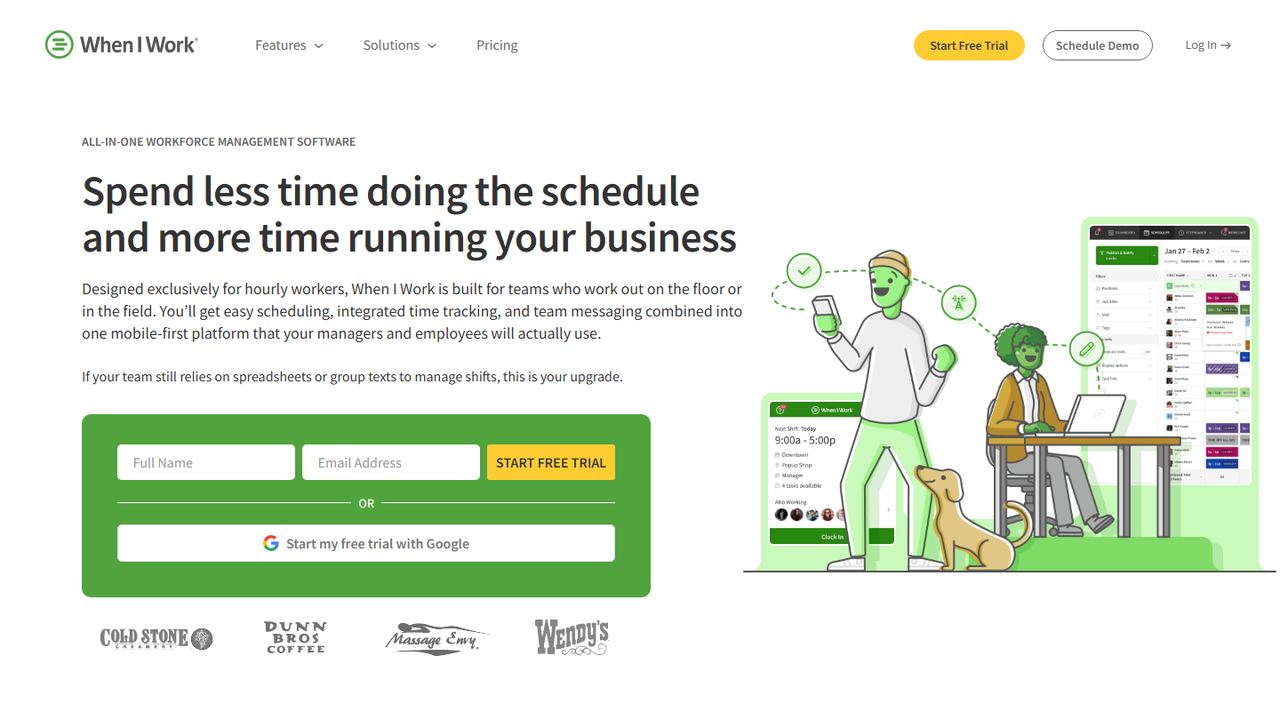
When I Work is a mobile-first scheduling app for hourly and shift-based teams, from coffee shops and retail stores to call centers and healthcare. It is the safest default for a team of 10 to 200 that wants the schedule built for them: even the cheapest Essentials plan includes auto-scheduling, multi-location schedules, forecast tools and OpenShifts, and you pay only for the users you have.
The auto-scheduler fills shifts in one click from each person’s eligibility, availability and preferences. OpenShifts post uncovered shifts to everyone qualified, swap requests go to a manager for approval, and team messaging keeps shift talk out of personal phone numbers. Attendance data syncs to payroll tools such as Gusto, QuickBooks Online, Paychex and Rippling.
Strengths
- Auto-scheduling, OpenShifts and swaps on the lowest plan
- Per-user pricing that stays low for small teams
- GPS and geofenced clock-in once you add time tracking
- Payroll integrations with Gusto, QuickBooks Online, Paychex and Rippling
Drawbacks
- No free plan, only a 14-day trial
- Time Tracking & Attendance is a separate add-on
- Scheduling rules and role permissions need the $5 Pro plan
- Best for
- single-location businesses that want to start free
- Free plan or trial
- Free for 1 location, up to 10 employees
- Starting price
- $30 per location/month (Essentials)
- Platforms
- Web, iOS, Android
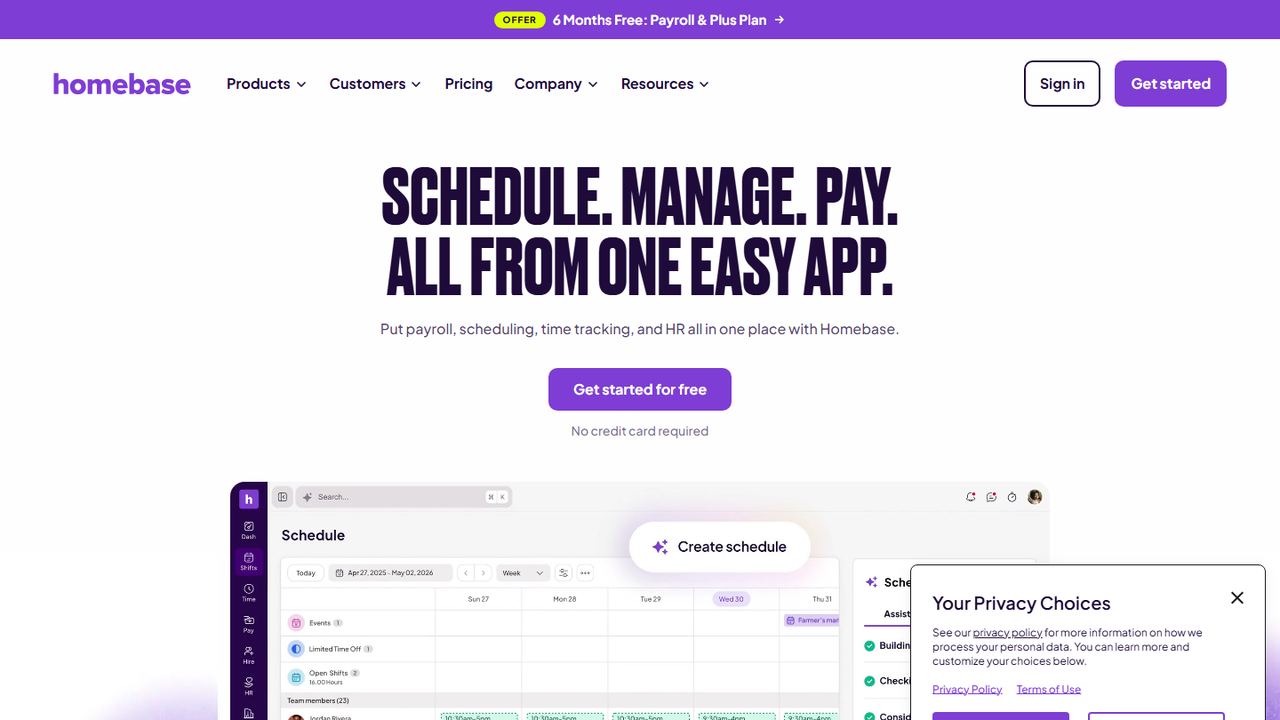
Homebase is scheduling, time tracking and team messaging for small local businesses such as cafes, salons, shops and clinics. Its Basic plan is free for one location and up to 10 employees and includes a weekly schedule builder and basic clock-in on a tablet, computer or POS. When you grow, you pay per location rather than per employee, which is unusual among scheduling apps.
Homebase prices by location, not by head, so paid plans cover unlimited employees. The schedule builder warns about overtime and conflicts before you publish, and it can show labor cost against a sales forecast pulled from Square, Clover, Shopify or Toast. Employees trade, cover and pick up open shifts from the app.
Strengths
- Free plan for one location with up to 10 employees
- Flat per-location price with unlimited employees on paid plans
- POS sales sync from Square, Clover, Shopify and Toast
- Payroll add-on in the same app ($49/month plus $6 per employee)
Drawbacks
- The AI scheduling assistant needs the $70 Plus plan
- Free plan stops at one location and 10 employees
- Payroll costs extra on every plan
- Best for
- multi-location teams and cities with fair workweek laws
- Free plan or trial
- Free trial up to 31 days; no free plan
- Starting price
- $5 per user/month (Lite)
- Platforms
- Web, iOS, Android, tablet kiosk
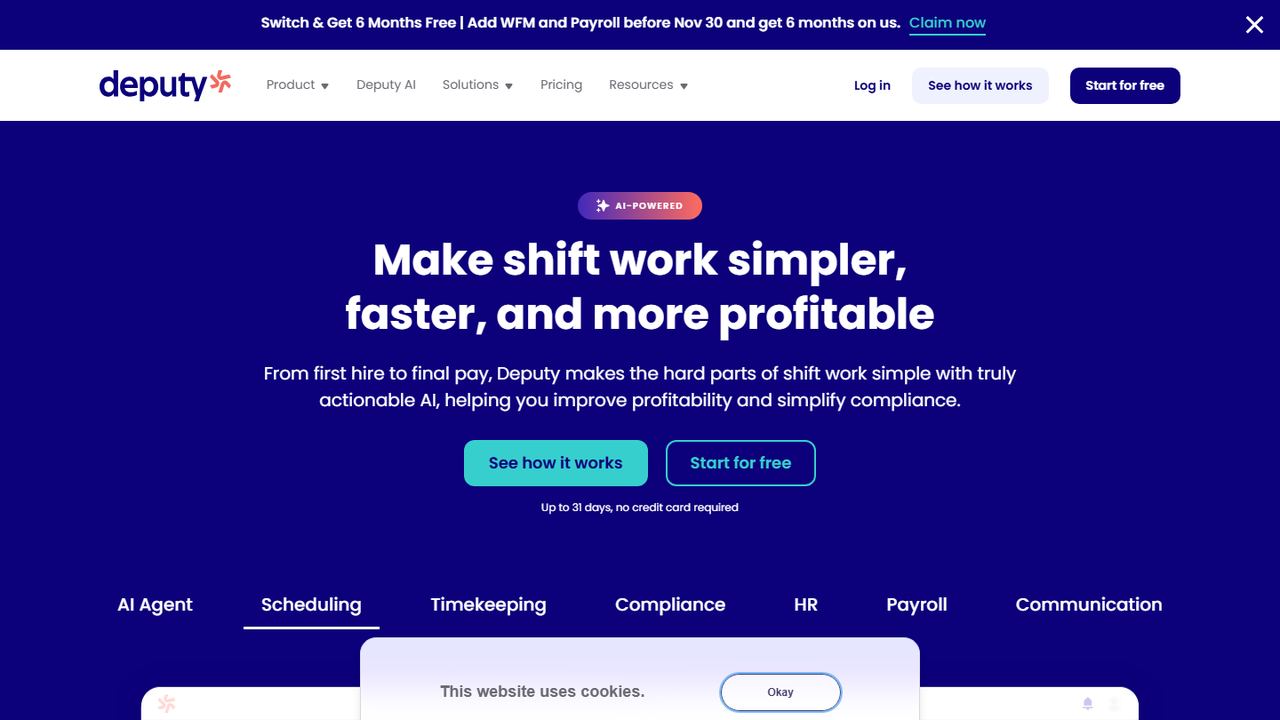
Deputy is employee scheduling software for shift-based businesses of every size, from a single cafe to franchises and enterprises in hospitality, retail and healthcare. It earns a place near the top for its compliance work: break planning, labor law rules and a dedicated fair workweek feature matter if you staff stores in a city with predictive scheduling rules, and its per-user plans scale across many sites.
Deputy’s auto-scheduler builds rosters from forecast demand, with priorities such as lowest cost or an even spread of hours. It plans paid rest breaks and unpaid meal breaks, flags missed ones, and offers a fair workweek compliance feature for cities with predictive scheduling laws. It connects to Square and Lightspeed POS, and payroll by Paycor is an add-on.
Strengths
- Auto-scheduling and demand forecasting (Core plan and up)
- Break planning and fair workweek compliance tools
- Biometric face clock-in on tablets with Core
- Built for multiple locations and franchises
Drawbacks
- No free plan
- Auto-scheduling is not in the $5 Lite plan
- $30 monthly minimum on monthly billing
- Best for
- field, cleaning and construction crews
- Free plan or trial
- Free for up to 10 users; 14-day trial
- Starting price
- $29/month for the first 30 users (Basic, annual)
- Platforms
- Web, iOS, Android
Connecteam is a mobile app for frontline and deskless teams in construction, cleaning, field service, security, healthcare and retail. Scheduling is part of its Operations hub, alongside the time clock. The Small Business plan is free for up to 10 users with every feature, and paid plans charge a flat monthly fee for the first 30 users, which keeps costs predictable for a growing crew.
The scheduler handles availability, swaps with admin approval, open shifts that qualified staff can claim, and daily, weekly or monthly templates. Before you publish it warns about conflicts, double bookings and overtime, and you can attach tasks to a shift. Chat, forms and HR tools live in the same app, which suits teams that rarely sit at a desk.
Strengths
- Free plan with every feature for up to 10 users
- One flat fee covers the first 30 users
- Shift tasks and chat in the same employee app
- Conflict and overtime warnings before publishing
Drawbacks
- Basic and free plans allow a single schedule
- On paid plans, repeating shifts and templates start on Advanced ($49/month)
- On paid plans, auto-assigning shifts needs Expert ($99/month)
- Best for
- the lowest per-user price, with a free plan up to 30 users
- Free plan or trial
- Free for up to 30 users; 15-day trial
- Starting price
- $1.70 per user/month (Premium, annual)
- Platforms
- Web, iOS, Android
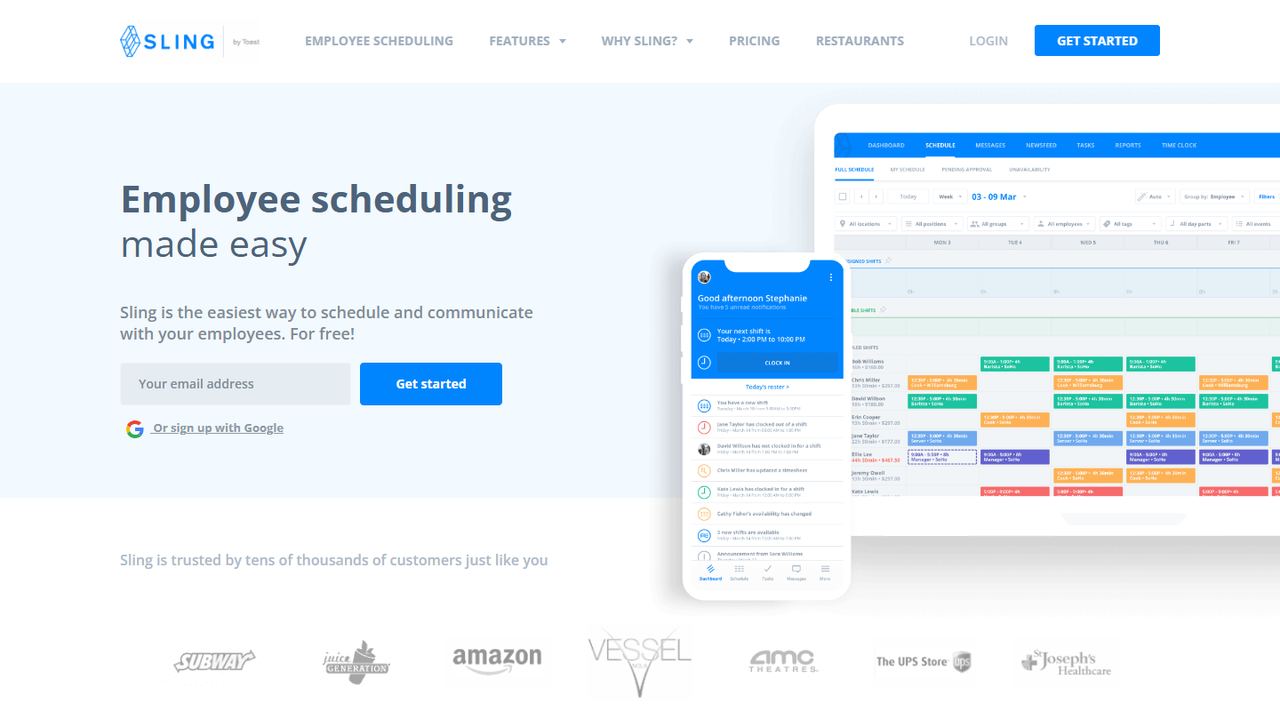
Sling is a shift scheduling app for small and mid-sized teams in restaurants, retail, healthcare, security and nonprofits, from two people to 200 or more across locations. Its free plan covers scheduling and private messaging for up to 30 users, the most generous free headcount on this list, and paid plans start below $2 per user per month on annual billing.
Sling, now owned by Toast, lets employees on the free plan see their shifts, request time off, offer shifts to coworkers and pick up open shifts. Premium adds unavailability, shift swaps, group messaging, a mobile time clock with overtime tracking, and labor cost alerts when a shift breaks the budget. Business adds shift tasks, kiosk clock-in and labor reports.
Strengths
- Free scheduling for up to 30 users
- Low per-user price on paid plans
- Labor cost and budget alerts as you schedule
- Open shifts and time-off requests on the free plan
Drawbacks
- Swaps, availability, time clock and labor cost need a paid plan
- Kiosk clock-in only on Business ($3.40 per user, annual)
- Sling recommends a desktop for building schedules
- Best for
- restaurants that schedule against POS sales
- Free plan or trial
- Free plan: 1 location, up to 15 employees
- Starting price
- $39.99 per location/month (Essentials, up to 30 employees)
- Platforms
- Web, iOS, Android
7shifts is an employee scheduling app made only for restaurants, from cafes and pizzerias to full-service groups and franchises. It belongs on any restaurant shortlist because it reads sales from your POS, knows restaurant labor rules and handles tips. The free Comp plan covers one location with up to 15 employees; paid plans are priced per location. See our restaurant scheduling apps list for more options.
7shifts is built only for restaurants. It connects to POS systems including Toast, Square, Clover, Lightspeed, TouchBistro and Aloha so you schedule against sales. Its compliance tools flag late changes under predictive scheduling rules in places such as Chicago, Seattle and Oregon and calculate predictability pay, check minor hour limits against a school calendar, and check California meal and rest breaks.
Strengths
- Restaurant features: POS sales, tips and labor targets
- Predictive scheduling and minor labor law checks
- Free Comp plan for one location
- Tip management and payroll in the same platform
Drawbacks
- Free plan capped at 15 employees and one location
- Prices rise with team size: Pro is $89.99 per location for 31+ employees
- Tip management is a $49.99/location add-on below Premium
7. Workzenly Our product
Best for businesses that want schedules, time and payroll in one system
- Best for
- businesses that want schedules, time and payroll in one system
- Free plan or trial
- Book a demo
- Starting price
- Book a demo
- Platforms
- Web, employee phone app, shared tablet clock
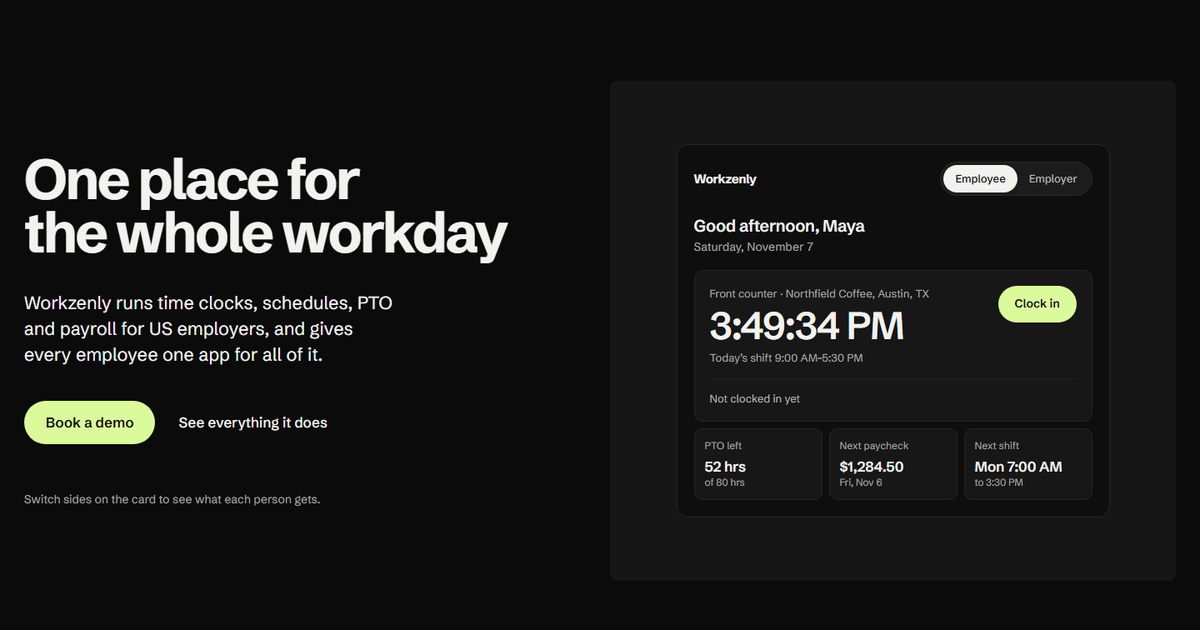
Workzenly is our product. It is workforce software for US small and mid-sized businesses with hourly and shift-based teams, such as restaurants, retail, healthcare, construction, field services, warehouses and offices. It fits best when the schedule is only half the job and you also want punches, PTO and payroll in the same place instead of three apps and an export.
Workzenly puts the schedule, time clock, PTO and payroll in one system with one employee app. Managers build shifts and approve swaps; employees clock in on their phone with GPS and geofencing or on a shared tablet. Approved hours and PTO flow into payroll, and pay stubs appear in the app. Onboarding forms are e-signed, and documents and performance reviews live in the same place.
Strengths
- Schedule, time clock, PTO and payroll in one system
- GPS and geofenced phone clock-in, or a shared tablet
- Pay stubs and PTO balances in the employee app
- Onboarding with e-signed forms
Drawbacks
- No published price; you get pricing in a demo
- No self-serve signup; you start with a demo
- Best for
- small teams that want a free plan up to 20 users
- Free plan or trial
- Free for up to 20 users, 1 location; 14-day trial
- Starting price
- $2 to $2.50 per active user/month (Starter)
- Platforms
- Web, iOS, Android
ZoomShift is a simple scheduling and time clock app for businesses with hourly employees in retail, restaurants, hospitality, healthcare and services. It suits a small team that wants something cleaner than a spreadsheet without paying much: the free Essentials plan covers up to 20 users at one location, and paid plans are priced per active team member, so seasonal staff you deactivate stop costing money.
ZoomShift keeps it simple. The free plan gives you a drag-and-drop schedule, shift confirmations and automatic reminders. Starter adds templates, availability, time-off rules with minimum notice periods, shift cover requests and swaps, calendar sync and a time clock with timesheets. Premium adds auto-scheduling, overtime warnings and a geofenced clock that can block early or late clock-ins.
Strengths
- Free plan for up to 20 users
- Low per-user price for small teams
- Time-off rules with minimum notice periods
- Geofenced clock that blocks early clock-ins (Premium)
Drawbacks
- Free plan has no time clock and schedules only 2 weeks ahead
- Auto-scheduling and overtime warnings need Premium
- Swaps, templates and availability start on Starter
- Best for
- teams that need to verify where and how staff clock in
- Free plan or trial
- Free for up to 10 members; 14-day trial
- Starting price
- $29/month including 30 members (Pro), then $3.50 each
- Platforms
- Web, iOS, Android
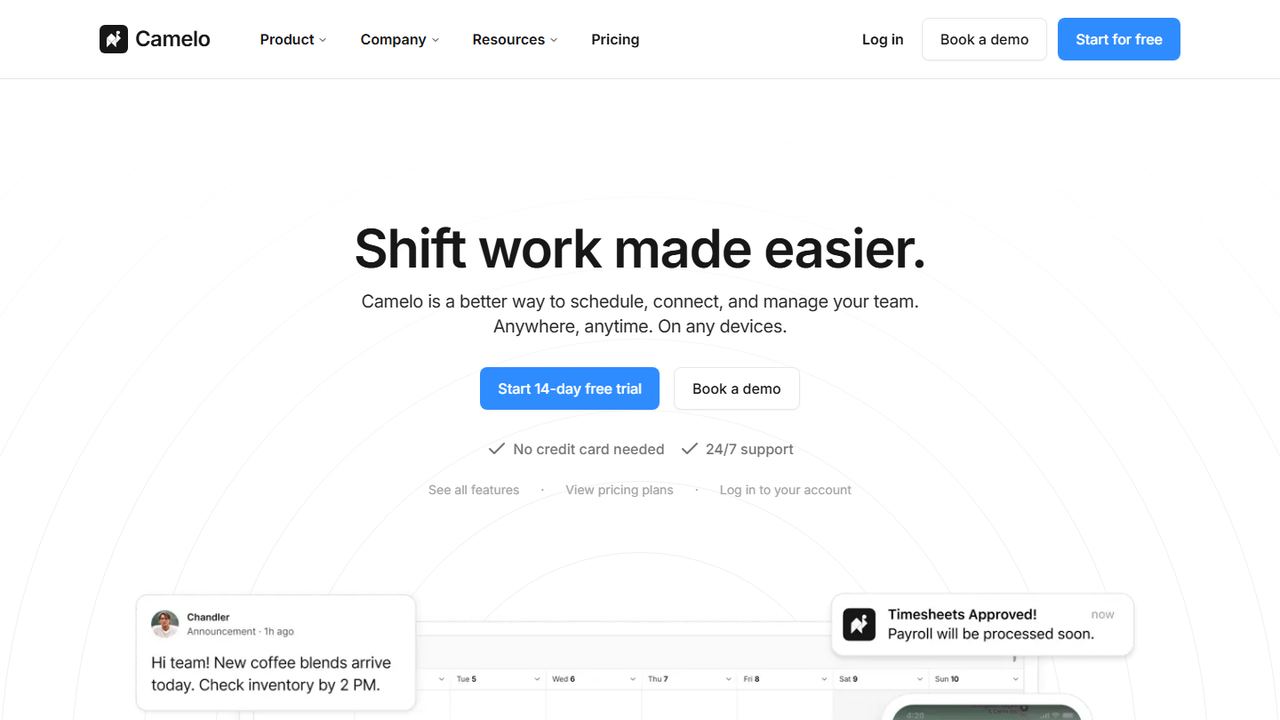
Camelo is a scheduling, time clock and team chat app for shift-based teams in restaurants, retail, cleaning, construction, security, salons and caregiving. It suits owners who worry about buddy punching or staff clocking in from the parking lot, because it can check each clock-in by GPS, geofence, photo or Wi-Fi. A free plan covers up to 10 members on one schedule.
Camelo pairs a drag-and-drop scheduler (templates, recurring shifts, shift trading, open shift claims and availability) with a time clock that can check clock-ins by GPS, geofence, photo or Wi-Fi. Hours flow into timesheets you approve and export for payroll, and announcements, group chats and channels sit in the same app.
Strengths
- Free plan for up to 10 members
- Four ways to verify clock-ins: GPS, geofence, photo, Wi-Fi
- Messaging, tasks and documents in the same app
- 14-day trial with no credit card
Drawbacks
- Free plan allows one schedule
- Payroll integration and labor forecasting are Premium-only ($99/month)
- Job sites cost $1.90 each per month on Pro
How we chose these scheduling apps
Our criteria
- Built for shift work. Each app publishes schedules to employees’ phones and supports swaps or open shifts. General calendar and appointment-booking tools were left out.
- Available to US businesses today, with a US website, US pricing and an app for iOS and Android or a web app.
- Verified on the vendor’s own site on November 7, 2026: features, pricing page, free plan or trial and platforms. We did not copy review-site ratings.
- Different buyers. We kept tools that win for a specific buyer (free, restaurants, compliance, field crews) instead of nine near-identical options.
- Transparent cost. Tools that publish prices ranked ahead of similar tools that do not.
How to choose employee scheduling software
Start with your headcount, number of locations and the one problem that costs you the most today: no-shows, overtime, last-minute swaps or payroll errors. Then check each shortlisted app against this list.
- Price model. Per-user pricing (When I Work, Deputy, Sling) is cheapest for small teams. Per-location pricing (Homebase, 7shifts) wins when one site has many part-timers. Flat-fee bundles (Connecteam, Camelo) are predictable up to 30 users. Model your real headcount, including seasonal staff.
- Free plan limits. Free plans cap users (5 to 30), locations (usually one) or features (often no time clock). Check which limit you will hit first.
- Overtime warnings. Under the federal Fair Labor Standards Act, non-exempt employees earn 1.5 times their regular rate for hours over 40 in a workweek, and California adds daily overtime after 8 hours. An app that warns you before you publish a 44-hour week saves real money. Our guide to how to calculate overtime shows the math.
- Predictive scheduling laws. Some employers must post schedules in advance and pay a premium for late changes. Oregon requires 14 days’ notice for large retail, hospitality and food service employers, Chicago requires 14 days in covered industries, and New York City requires 14 days for fast food and 72 hours for retail. If that applies to you, pick an app with fair workweek tools.
- Breaks and minors. Federal law does not require meal breaks, but short rest breaks of 20 minutes or less must be paid, and states such as California require meal and rest periods. Federal rules also limit 14- and 15-year-olds to 3 hours on a school day and 18 hours in a school week. Apps that flag these save you from fixing them later.
- Time clock and payroll. A schedule is only a plan. Check whether clock-ins compare against it, whether a GPS time clock is included or an add-on, and how hours reach payroll.
- Employee experience. Ask two employees to install the app during the trial, trade a shift and request time off. If they can’t do it unaided, adoption will stall.
Running rotating 12-hour coverage? Our explainers on the DuPont schedule and the 2-2-3 schedule show patterns you can load into any of these apps as templates.
Frequently asked questions
What is the best employee scheduling app?
For most US hourly teams, When I Work is the best all-round employee scheduling app because auto-scheduling, OpenShifts and swaps are in its lowest plan at $2.50 per user per month. Homebase is better if you have one location and want a free plan, Deputy if you face fair workweek rules, and 7shifts if you run a restaurant.
Is there a free employee scheduling app?
Yes. Sling is free for up to 30 users, ZoomShift for up to 20 users at one location, Homebase for one location with up to 10 employees, Connecteam and Camelo for up to 10 users, and 7shifts for one restaurant with up to 15 employees. Free plans usually leave out the time clock, labor cost tools or multiple locations.
How much does employee scheduling software cost?
Per-user apps run from about $1.70 to $9 per user per month. Per-location apps such as Homebase start at $30 per location per month, and 7shifts at $39.99 per location for teams up to 30. Connecteam and Camelo charge $29 a month for the first 30 users. Enterprise tools such as HotSchedules quote on request. Check each vendor’s pricing page for current offers.
Can a scheduling app prevent overtime?
Many can warn you. Homebase, Connecteam and ZoomShift Premium flag shifts that push an employee past 40 hours before you publish, and several also block early clock-ins. The app cannot stop you from approving extra hours, and you still owe overtime for every hour actually worked, scheduled or not.
Do employee scheduling apps handle predictive scheduling laws?
Some do. Deputy has a fair workweek feature, and 7shifts and HotSchedules flag late changes and premiums for restaurants in cities with these rules. Most small-business apps do not track predictability pay. If you are covered in Oregon, Chicago, New York City or another city with a law, confirm the specific rules each app supports.